Brandon A. Archer is an Arts Writer, Curator, and Black Studies PhD Student.
"Who knows but that, on the lower frequencies, I speak for you?", Ralph Ellison, Invisible Man
—
"Who knows but that, on the lower frequencies, I speak for you?", Ralph Ellison, Invisible Man —
BrandonArcher(He/Him/His) is a Haitian-Trinidadian (un)disciplined PhD student in the Department of African Diaspora Studies at UC Berkeley.He earned a B.A. from Swarthmore College with a double major in English Literature and a Specialized Major in Black Studies entitled “Visual Cultures and Literature of the African Diaspora”. His research engages questions of Black visuality—considering the aesthetics and political stakes of mourning, madness, and embodiment.
He leads curatorial affairs, exhibitions, and programming for Oakstop’s five Downtown galleries and art across its locations—A Black-owned cultural campus and events hub supporting Oakland’s arts community and entrepreneurial ecosystems.
Supported by his time as a Mellon Mays Fellow and a member of the 2024-2025 BES Arts Writing Incubator Cohort, his work has been recognized with the Philip M. Hicks Prize for Literary Criticism, and his recent essay is published in Issue 8 of the Black Embodiments Studio journal, “A Year in Black Art”.
In 2020, he co-founded the Philadelphia Black Students’ Alliance, featured in the anthology How We Stay Free: Notes on a Black Uprising (Rogers, 2022), and served as Executive Director of the Philadelphia-based organization UrbEd, Inc. and Bullhorn News from 2021-2024. His efforts have contributed to the opening of an in-person youth space in Philadelphia, a First amendment case with the PAACLU, almost half a million dollars raised for public school advocacy, and comprehensive reports on the regression of student activist’s rights and civic space with the Norwegian Students’ and Academics’ International Assistance Fund. Brandon’s tenure and work has been recognized by UrbEd, Inc. with the Brandon Archer Kujichagulia Scholarship, awarded each year to a Philadelphia Public School Student.
Brandon is sustained by the intellectual traditions of his mother, Ralph Ellison, Elizabeth Alexander, Joseph Beam, Christina Sharpe, Sylvia Wynter, Kara Walker, Nick Cave, and Sun Ra—and by all those who indulge in illegibility.
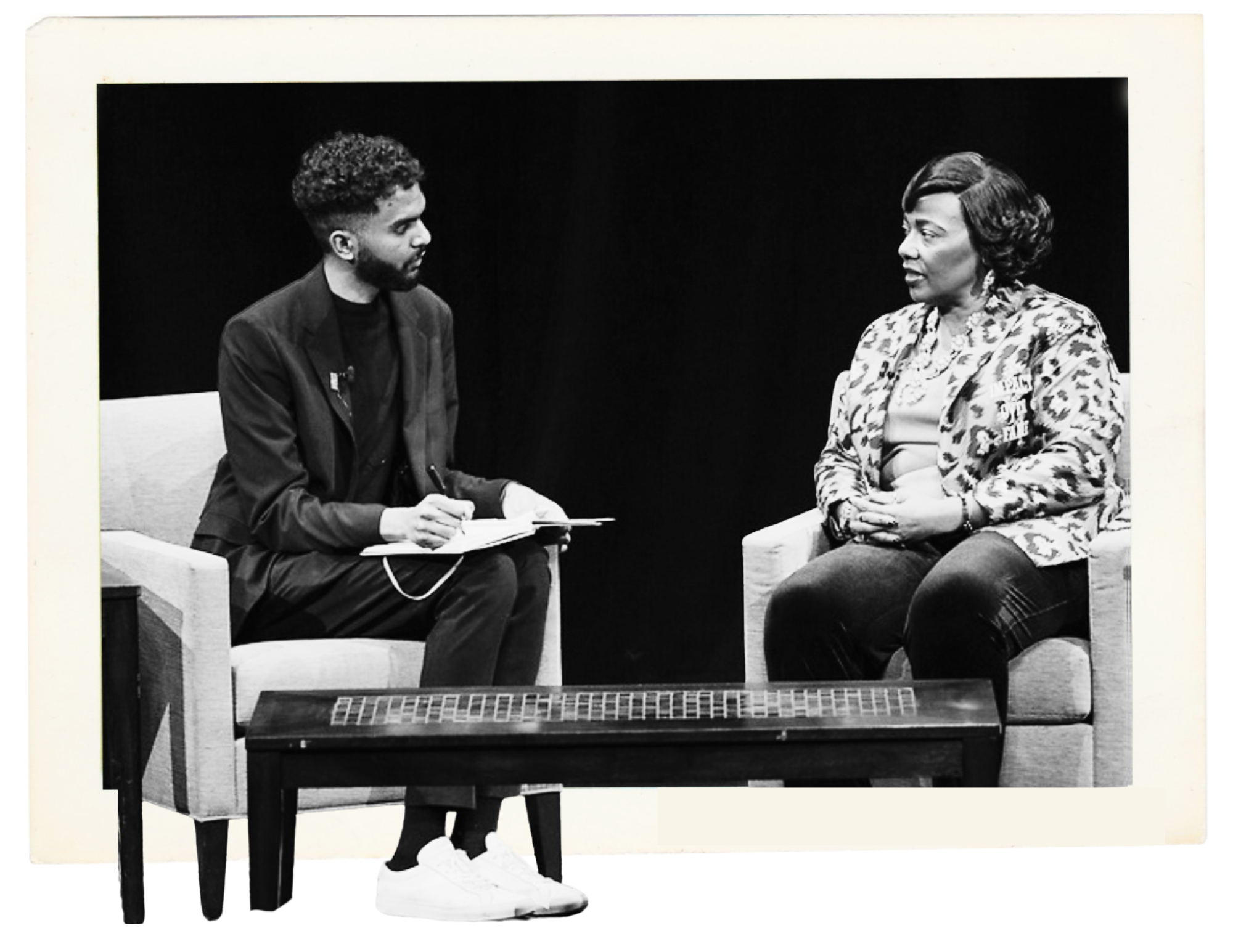
Archer and Dr.Bernice King (2025) Photo via Laurence Kesterson
“Yet we are connected: his past is my present, our present a foundation for the future.”
— Brother to Brother, Joseph Beam and completed by Essex Hemphill

Sun Ra and the Arkestra in front of 5626 Morton St. in Philadelphia, By Veryl Oakland
“I am learning to fly, to levitate myself. No one is teaching me. I’m just learning on my own, little by little, dream lesson by dream lesson...I’ve had many lessons, and I’m better at flying than I used to be. I trust my ability more now, but I’m still afraid. I can’t quite control my directions yet.”
— Octavia E. Butler

Nina Simone and James Baldwin, Bernard Gotfryd (1924–2016), 1965
“Despite knowing otherwise, we are often disciplined into thinking through and along lines that reinscribe our own annihilation, reinforcing and reproducing what Sylvia Wynter (1994, 70) has called our ‘narratively condemned status.’ We must become undisciplined. The work we do requires new modes and methods of research and teaching; new ways of entering and leaving the archives of slavery, of undoing the ‘racial calculus and . . . political arithmetic that were entrenched centuries ago’ (Hartman 2008, 6) and that live into the present”.
— Christina Sharpe, In the Wake: On Blackness and Being, 13